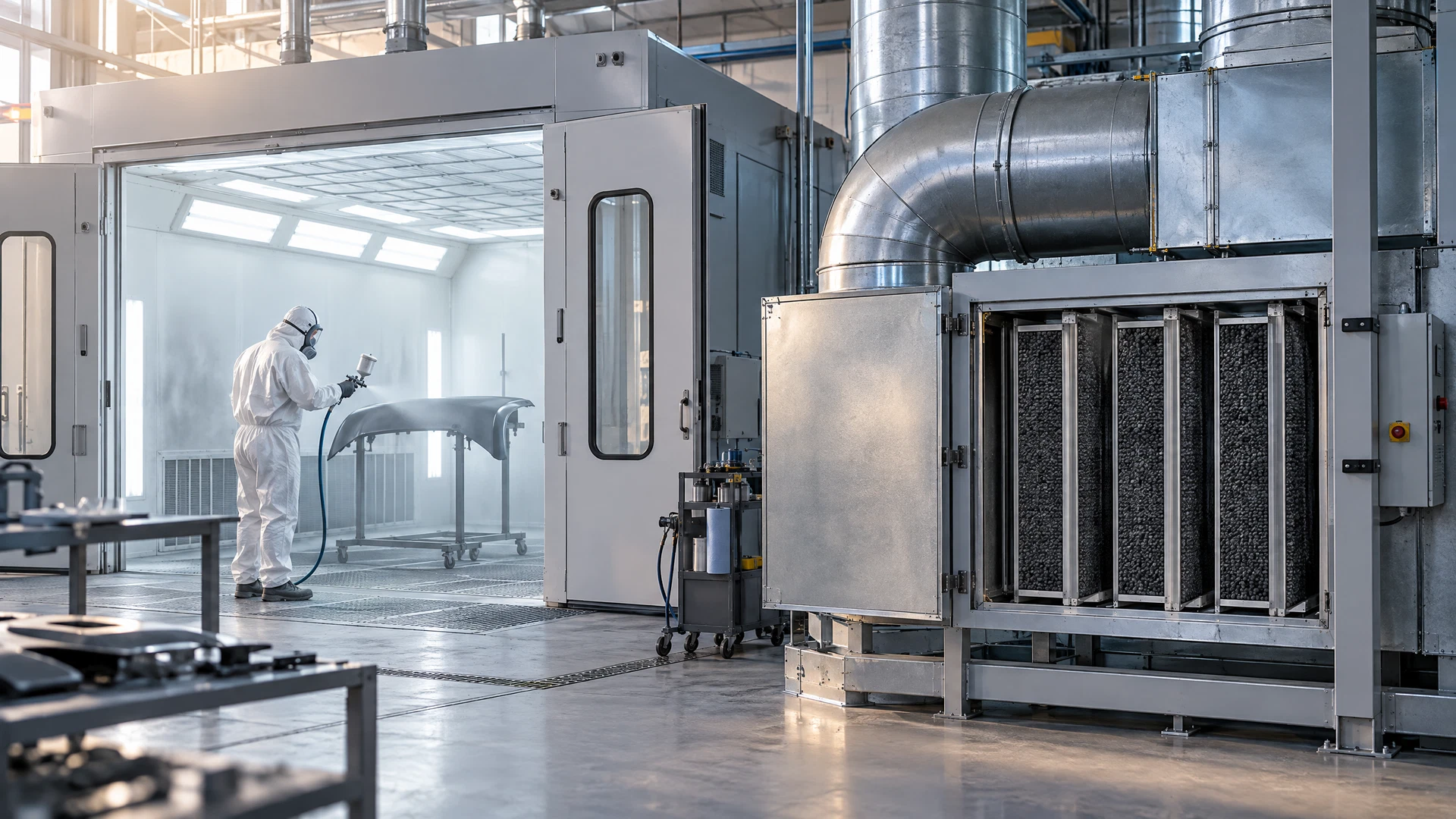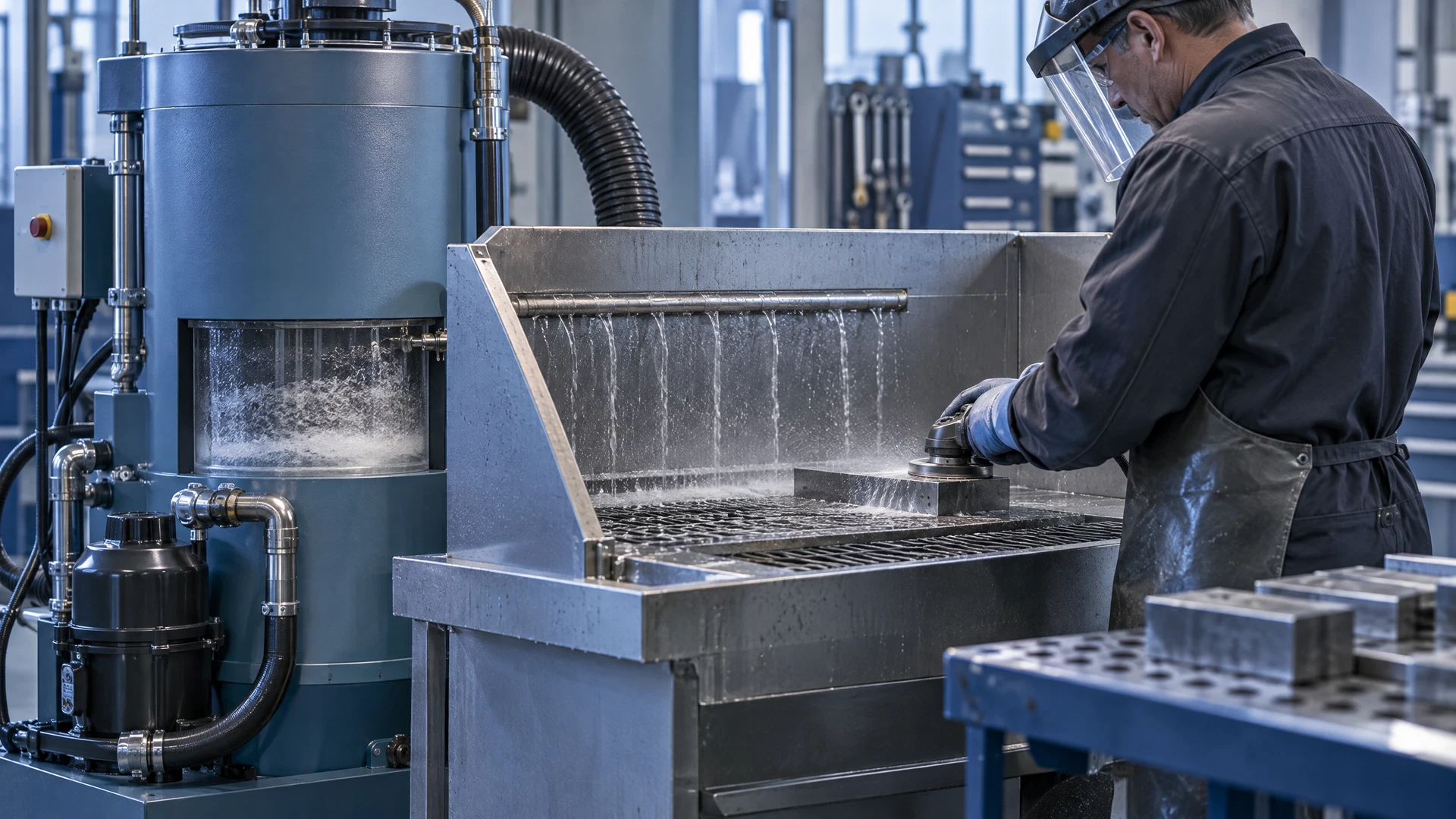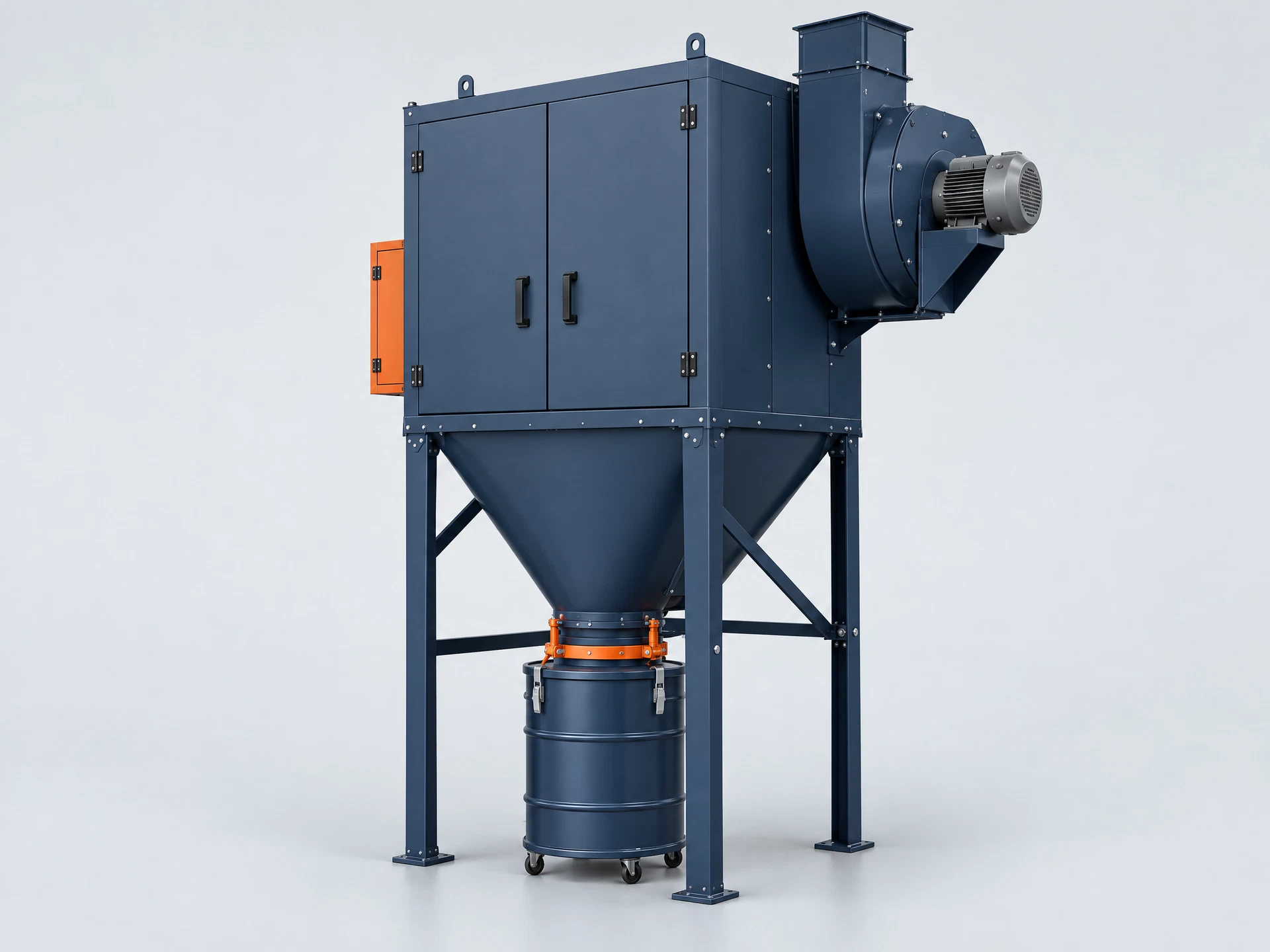
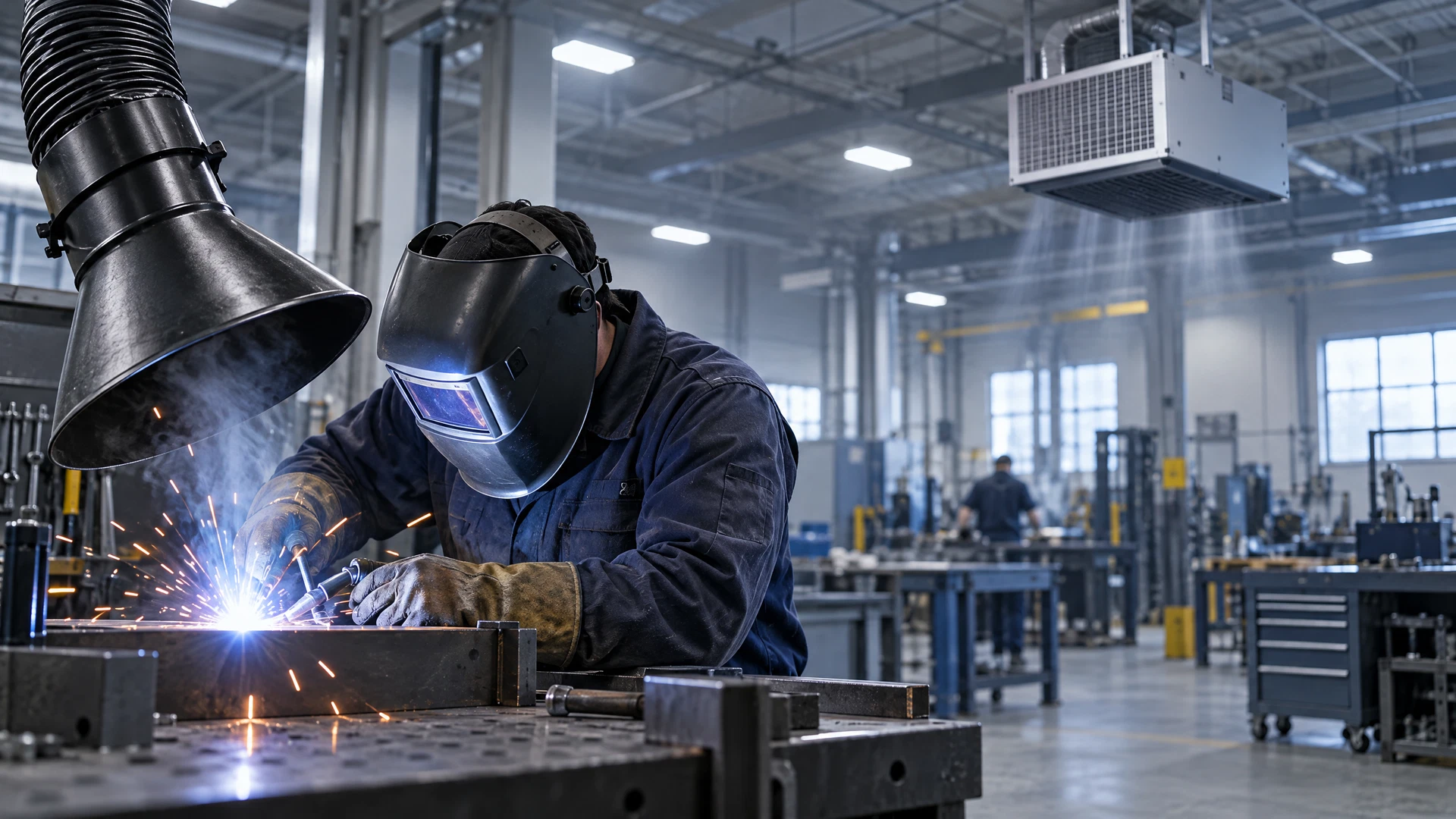
A welding arc, grinder, powder-transfer point or solvent process can release contaminants into a room. The sooner a control intercepts an emission, the less it can mix with the breathing-zone air and spread to other workstations. This is why a comparison of source capture and ambient filtration should begin with the process—not with a catalogue label.
What does source capture do?
Local exhaust ventilation (LEV) uses a hood, duct, air mover and suitable collection or exhaust arrangement to capture a contaminant at or close to its release point. The aim is to intercept the plume before it travels through the work area. OSHA describes local exhaust, general exhaust, make-up air and other functions as components that can be combined; deficiencies should be checked by measurement rather than assumed from appearance. Read the OSHA Technical Manual's ventilation guidance.
Source capture can be a strong candidate when the source is known and reasonably fixed: for example, a workbench, transfer point or enclosed process. It is not a guarantee of control. The hood has to work with the source's direction and momentum, the operator's position, nearby machinery, cross-drafts and the rest of the air system.
What does ambient filtration do?
An ambient air cleaner treats air after a contaminant has dispersed into a room. Depending on the equipment and the substance, it may reduce residual airborne particulate in a space or supplement a process-level control. General or dilution ventilation also supplies or exchanges air. It is not automatically equivalent to capturing a concentrated plume before it reaches a worker.
CCOHS explains that dilution ventilation mixes contaminants with cleaner air and can distribute pollutants through a worksite. Its guidance notes important limitations for highly toxic materials, dust, metal fumes, high contaminant loading and irregular surges. These are prompts to assess the actual hazard, not a universal ruling that ambient treatment can never be useful. See CCOHS's ventilation introduction.
Why does hood position matter?
A hood should generally enclose a source or be placed as close as practicable. The hood opening and airflow need to account for the process and the path the contaminant takes. A worker should not have to lean between the source and the hood, where the plume could pass through the breathing zone first.
Cross-drafts from doors, fans, vehicle movement, room currents or neighbouring equipment can disrupt a capture pattern. The CCOHS guide to hood selection and positioning discusses these factors. Published rule-of-thumb distances are not universal design targets; the appropriate arrangement and verification method depend on the hood and process.
Can the two approaches be combined?
Yes. A facility may use LEV at a strong or predictable source and ambient treatment for a separate background particulate concern. General ventilation may provide make-up air or support room conditions. The components need to be considered together so one fan or air jet does not weaken another hood's capture.
Combustible dust adds another layer. OSHA's technical manual flags collection systems that handle known combustible dust and return exhaust indoors as a potential hazard indicator. That does not establish that every indoor return is prohibited, nor does a filter specification settle the question. The material, collector, protection, isolation and installation require a competent, site-specific review.
What information should a shop gather?
Record what is released, where and when it is released, how it moves, and who works nearby. Note whether it is particulate, fume, mist or vapour; whether the rate varies; and whether sparks, heat, flammability, toxicity or water-reactive materials may be involved. A supplier or ventilation professional may need process drawings, workstation locations, existing fan data and any relevant sampling or exposure information.
Then ask how the proposed hood will sit relative to the source and operator, what could cause cross-drafts, where captured material goes, how make-up air enters, how performance will be commissioned, and how maintenance will be verified. There is no one number in this article that can size a system for every shop. For a related overview of VOC streams, see industrial VOC control options.
Bottom line: evaluate source capture first for a known, capturable emission. Use ambient filtration as a complementary control only where the contaminant and system make it appropriate. Have the complete arrangement reviewed and measured for the real process.